Field note · Inventory
Inventory Risk Before Scaling Ads: A Cash-Aware Reorder Model
A positive contribution margin does not guarantee that an advertising plan can survive its next supplier payment. Stock, cash and unsettled sales move on different calendars. This synthetic educational model follows one product for 60 days, exposing an affordable but late reorder. It is not a merchant case study, forecast or record of business results. All dollar amounts are USD.

Define the cash boundary
Day 0 opens with $10,000 cash and 300 sellable units already owned and paid for. Nothing ships that day. From day 1, demand is 10 single-unit orders daily, price is $40, and landed product cost is $12 per unit. The separate $8 variable cash cost per shipped order includes advertising, outbound fulfillment and payment fees. These are assumptions, not quoted platform rates.
Pay the full $6,000 procurement amount for 500 units on day 10; there is no later balance. A 30-day supplier lead time delivers them at the start of day 40. Ship only available units, then collect the gross sales value from shipments seven days earlier at each day's end. Pay variable costs on shipment day. Lost demand disappears rather than becoming a backorder.
The model excludes taxes, returns, overhead, interest and cash flows from other products. Advertising is assumed entirely shipment-linked here; campaigns that keep spending during stockouts need a separate daily cash line.
Audit the 60-day cash schedule
Available units = opening units + start-of-day receipts
Shipped units = min(demand, available units)
Closing units = available units - shipped units
Payout on day t = $40 × shipments[t - 7]
Closing cash = opening cash + payout - ($8 × shipments) - procurement payment
Shipments before day 1 are zero. The synthetic cash-flow CSV contains 61 daily records, day 0 through day 60, plus a header. Each row separates demand, receipts, shipments, lost orders, cash movements, receivables and inventory value. It never allows negative stock.
| Day | Event | Closing cash | Units left |
|---|---|---|---|
| 0 | Opening balances only | $10,000 | 300 |
| 7 | Seven shipment days, no payouts | $9,440 | 230 |
| 10 | Full procurement payment | $4,400 | 200 |
| 30 | Opening inventory exhausted | $10,800 | 0 |
| 39 | Ninth lost-demand day | $13,600 | 0 |
| 40 | Receive 500, ship 10 | $13,520 | 490 |
| 60 | End of horizon | $17,520 | 290 |
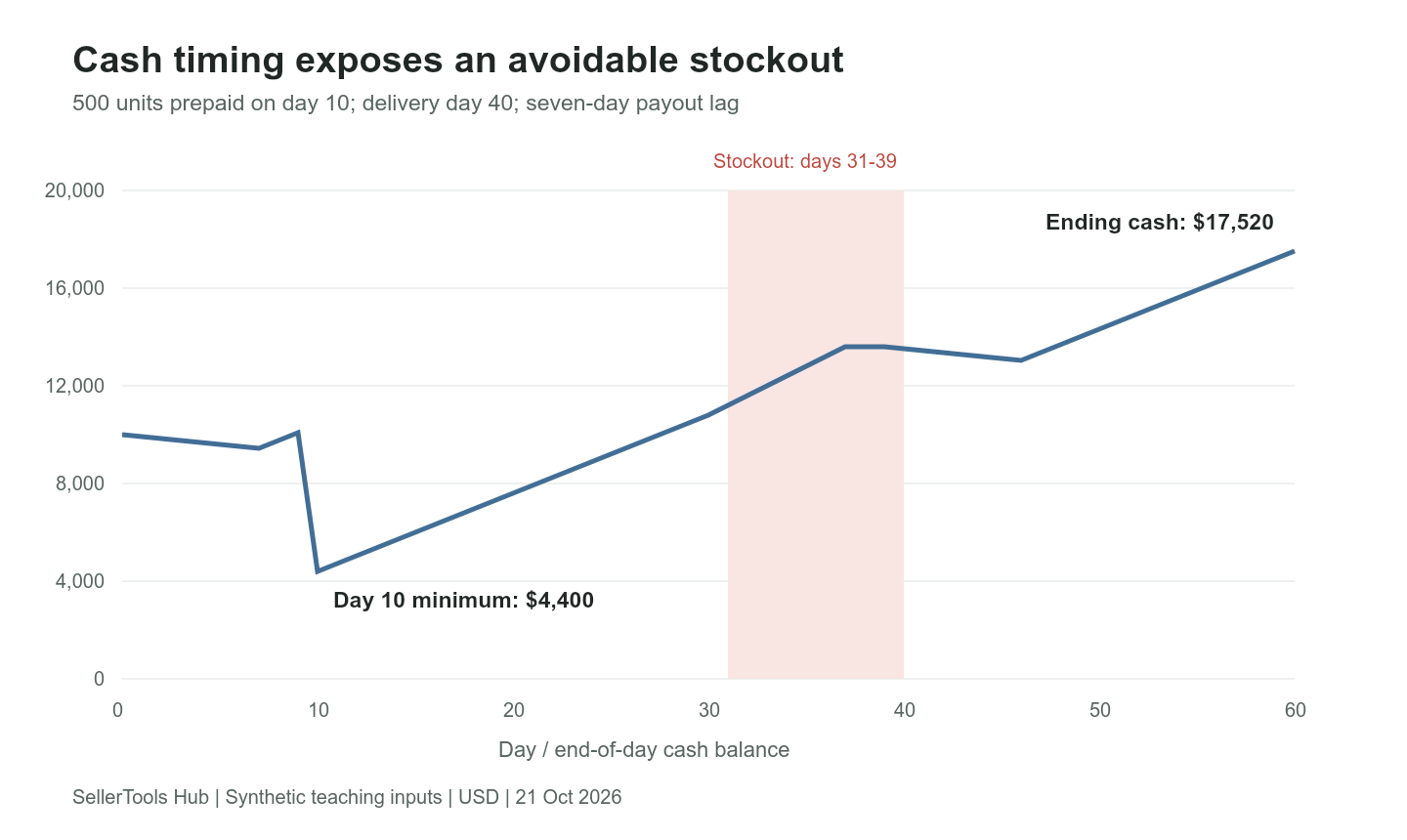
Days 1-30 ship 300 units; days 31-39 lose 90 orders; days 40-60 ship 210. Payouts total $17,600: $12,000 on days 8-37 and $5,600 on days 47-60. Variable cash costs total $4,080. Thus $10,000 + $17,600 - $4,080 - $6,000 = $17,520 ending cash. The minimum closing balance is $4,400 on day 10: day 9's $10,080 plus $400 payout, minus $80 operating cost and $6,000 procurement.
Reconcile contribution, cash and assets
Per-unit contribution is $40 - $12 - $8 = $20, or 50% of revenue. The 510 shipments generate $20,400 revenue, $6,120 cost of goods sold and $4,080 variable expense: $10,200 contribution before excluded overhead, not net business profit.
Cash rose only $7,520. Shipments from days 54-60 leave $2,800 receivable, not spendable cash. Ending stock is 290 units worth $3,480 at cost, versus opening stock worth $3,600. The reconciliation is $10,200 contribution - $2,800 increase in receivables + $120 inventory reduction = $7,520 cash increase. Opening stock is expensed as sold, but never paid for again inside this schedule. The reorder converts cash into inventory; do not expense all 500 purchased units immediately as cost of goods sold.
An affordable reorder can still be late
Opening cover is 300 ÷ 10 = 30 days. A planning reorder point with a seven-day safety buffer is daily demand × (lead time + buffer): 10 × (30 + 7) = 370 units. Opening inventory is already below that trigger. By day 10 close, only 200 remain; paying the supplier then cannot erase the delivery gap.
The buffer protects supply uncertainty, not payout timing. An earlier order, confirmed faster delivery or lower demand is needed to change availability. Check sellable stock by variant: damaged, reserved or unavailable units cannot fulfill new demand. A healthy total cash balance cannot substitute for the missing size or SKU.
Use inventory position when checking whether another purchase is needed: sellable units plus confirmed inbound units minus existing backorders. However, inbound stock is not shippable until received. After the day 10 purchase, the pipeline contains 500 units, but availability still runs out before arrival. Treating that pipeline as immediately available hides the stockout; ignoring it entirely can trigger a duplicate purchase and unnecessarily lock up more cash.
Stress-test growth and settlement separately
| Scenario | Minimum cash | Day 60 cash | Lost orders | Units left |
|---|---|---|---|---|
| Base: 10/day, lag 7 | $4,400 | $17,520 | 90 | 290 |
| Demand +50%: 15/day | $4,600 | $19,480 | 285 | 185 |
| Payout lag 14 days | $2,880 | $14,720 | 90 | 290 |
| 15/day and lag 14 | $2,320 | $15,280 | 285 | 185 |
At 15/day, opening stock lasts through day 20, creating 19 lost-demand days before delivery. Higher ending cash conceals worse service. The combined stress case retains positive contribution yet breaches a hypothetical $3,000 cash floor. With demand halved to five/day, nothing stocks out, but 500 units remain on day 60, tying up $6,000 at cost. Both faster and slower sales can make the same purchase quantity unsuitable.
Extending the lag alone changes neither shipments nor contribution. It moves the first payout to day 15 and the cash trough to day 14, when closing cash reaches $2,880. In the combined stress case, that day's balance is $2,320. These are settlement problems, not evidence that product margins deteriorated. Credit might bridge timing, but repayment and interest would need their own schedule.
Set a cash floor and date every invoice
A $3,000 floor leaves only $1,400 closing-cash headroom in the base case. Treat that floor as an illustrative policy, not a universal reserve. Add actual rent, payroll, refunds and tax due dates before approving spend. End-of-day solvency also does not guarantee funds for a morning invoice when payouts arrive that evening.
For upfront procurement, reserve the entire payment before ordering. For deposit-and-balance terms, replace the single outflow with each contractual due date; moving payment changes cash timing, not automatically delivery. Do not promise an earlier reorder using unsettled receipts. Approve scaling only when contribution, stock coverage and the stressed cash floor all pass. Reconcile actual shipments and bank deposits daily, and revise lead time when receiving dates change.
Record who confirmed each supplier date and distinguish contractual payment deadlines from estimates. A delayed balance payment is not free financing unless the supplier has actually agreed to those terms.
60-day inventory cash model
- Minimum closing cash
- $4,400.00
- Day 60 cash
- $17,520.00
- Lost orders
- 90
- Day 60 units
- 290
Synthetic educational base case. Minimum closing cash occurs on day 10; no backorders or additional financing are assumed.
FAQ
Why does cash rise during the stockout?
Earlier shipments still settle on days 31-37 while shipment-linked costs stop. That temporary cash improvement masks lost demand, not better operations.
Should I subtract advertising again?
No. The $8 already includes ads, outbound fulfillment and payment fees. Replace its components with actual costs without duplicating them.
Does day 30 count as a lost-order day?
No. Its final 10 units fulfill demand. Zero closing stock differs from unmet demand; lost orders begin on day 31.
Is pending payout the same as available cash?
No. The $2,800 receivable is earned but uncollected at day 60. Actual holds, deductions or failed payouts require additional assumptions.
Can this determine my next purchase order?
It supports a timing check, not a purchase recommendation. Add supplier minimums, variant demand, returns, storage and confirmed payment terms first.
Sources and verification
Shopify's official inventory reports documentation, checked October 21, 2026, explains inventory coverage metrics and stock states. Its current on-hand reporting can include committed or unavailable units; reconcile those with sellable stock. This source supports definitions, not the synthetic assumptions or results.
Sum CSV payouts, variable costs and procurement separately; reconcile closing cash and units to their opening balances. All schedule data are synthetic and educational.