Field note · Pricing
Coupon Strategy Without Destroying Contribution Margin
A coupon can increase orders and revenue while reducing the money available to pay overhead. The missing comparison is contribution per eligible visitor. This worked analysis prices a $5 coupon on a $50 product, allows for lower percentage fees, and calculates the conversion rate that would preserve the original contribution. The same assumptions power the editable model and downloadable sensitivity table below.

Build a baseline that includes the cost of traffic
Consider one product with a $50 price, $25 landed goods cost and $5 fulfillment cost. A hypothetical variable fee is 8% of the discounted merchandise price. This is a model input, not a quoted rate for any platform. The baseline receives 1,000 eligible sessions at $0.25 per session, and 3% of sessions become orders. Traffic costs $250 whether 30 or 38 visitors buy.
Without a coupon, contribution before traffic is $50 − $25 − $5 − $4 = $16 per order. Thirty orders generate $480 before traffic and $230 after the $250 traffic bill. Fixed overhead and tax remain outside this example. So do any change in return behavior, basket size or repeat purchases; those must be evaluated separately rather than credited to an unproven promotion.
| Cost line | No coupon | $5 coupon |
|---|---|---|
| Merchandise revenue | $50.00 | $45.00 |
| Landed goods | −$25.00 | −$25.00 |
| Fulfillment | −$5.00 | −$5.00 |
| Illustrative 8% variable fee | −$4.00 | −$3.60 |
| Contribution before traffic | $16.00 | $11.40 |
A 10% price discount needs 40.35% more orders here
The seller gives away $5, but saves $0.40 in percentage fees, so contribution falls by $4.60. Simply subtracting the coupon from the original contribution would overstate the required lift. Conversely, ignoring the lost contribution because the platform fee got smaller would understate it.
Baseline conversion × baseline contribution per order ÷ discounted contribution per order
3% × $16 ÷ $11.40 = 4.2105% conversion
The conversion rate must rise by 1.2105 percentage points, or 40.35% relative to its baseline. At 1,000 sessions the planning threshold is 42.105 orders. Real orders are integers, so at least 43 orders would beat the $230 baseline in this particular 1,000-session batch. Keep the unrounded rate for planning; rounding it to 4.2% slightly undershoots the target.
| Offer | Conversion | Orders | Revenue | Contribution after traffic |
|---|---|---|---|---|
| No coupon | 3.0% | 30 | $1,500 | $230.00 |
| $5 coupon | 3.8% | 38 | $1,710 | $183.20 |
| $5 coupon | 4.5% | 45 | $2,025 | $263.00 |
| $10 coupon | 4.5% | 45 | $1,800 | $56.00 |
The 3.8% case increases revenue by 14% but reduces contribution after traffic by $46.80, or 20.35%. It is a useful warning against choosing the winning offer by revenue alone. These are arithmetic scenarios, not evidence that a coupon causes any particular conversion rate.
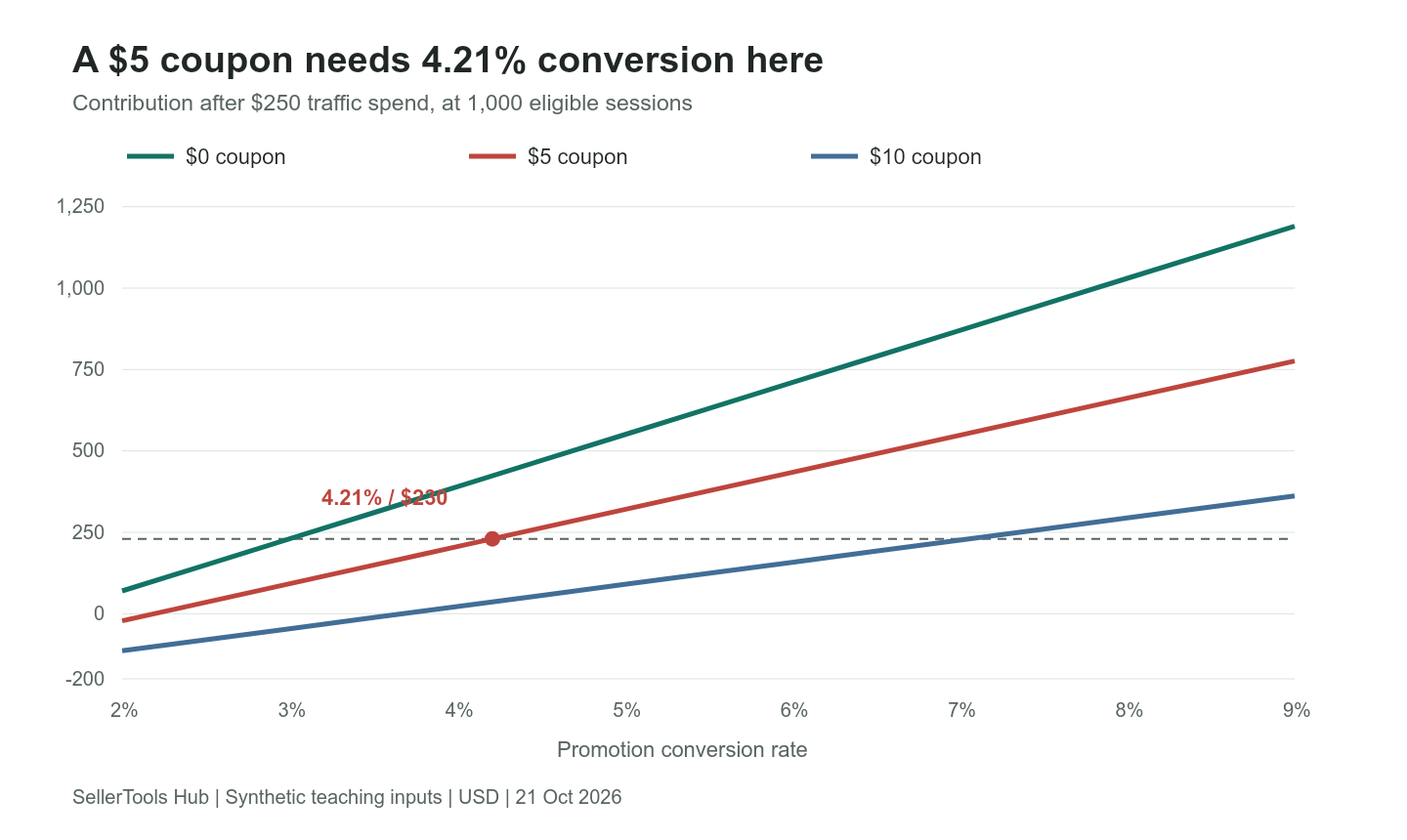
Coupon contribution comparison
- Baseline contribution after traffic
- $230.00
- Promotion contribution after traffic
- $183.20
- Change in contribution
- −$46.80
- Conversion needed to match baseline
- 4.21%
The comparison holds eligible sessions and traffic cost constant. Refunds and fixed overhead are outside the example.
Check who pays and what can stack
Use the seller-funded amount from settlement records. A marketplace subsidy may lower the shopper's payment while leaving seller revenue unchanged; it cannot automatically be modeled like a seller-funded coupon. Likewise, free shipping can add a cost without reducing merchandise revenue. Keep those adjustments in distinct rows and inspect a test order before launching.
Shopify distinguishes product, order and shipping discounts, and combinations depend on eligibility and settings. Its official guidance also describes the calculation order. Verify your actual checkout because two visible promotion labels do not reliably describe the amount deducted from settlement. Record the final merchandise revenue, shipping revenue and all seller-funded reductions once each.
Explain the lift before repeating the offer
Extra orders can come from customers who would have purchased next week at full price. Compare the period after the offer ends, not just its busiest day. Segment new and returning buyers, examine bundle mix, and wait for refunds to mature. A promotion that attracts more low-contribution products may look stronger in total revenue while weakening the mix.
Separate a financial threshold from experimental evidence
The 4.2105% threshold answers what would have to happen. It does not establish that the offer produced a change. Thirty versus 38 orders is a small observation, and changes in audience, stock availability, creative or weekday can explain part of the difference. A fixed declaration such as “200 sessions prove the coupon works” would be unjustified.
Define the eligible audience and measurement window before testing. Where practical, randomize offer exposure and keep campaign treatment consistent. Record sessions, checkout orders, settled revenue, refunds and contribution for each group. Evaluate uncertainty alongside the financial threshold; a noisy apparent lift can still be too weak to justify a permanent lower price.
Choose an operating decision before extending the test
For this model, a measured 3.8% rate is financially below the required rate. The next decision could be a shallower discount, lower fulfillment cost or a clearer product page rather than a larger traffic budget. Write down the maximum test spend you can afford to lose, who can end the promotion, and when mature returns will be reviewed. Those limits belong to the business's cash position; they are not universal market benchmarks.
Questions and limitations
Does a higher order count mean the coupon worked?
Not by itself. Compare contribution at the same eligible traffic exposure and include any change in refunds, basket mix and traffic cost.
Why use contribution per visitor instead of only margin percentage?
A lower margin can produce more total contribution if enough extra visitors buy. Contribution per eligible visitor connects both effects without ignoring the cost of traffic.
What happens if discounted contribution reaches zero?
There is no finite positive conversion lift that restores a profitable baseline under this model. Every extra order adds no contribution before traffic.
Can I use a percentage coupon?
Convert it to the seller-funded dollar amount for this product and order value. For mixed baskets, model each meaningful basket separately.
What if customer acquisition cost changes during the offer?
The equal-traffic-cost formula no longer fully describes the comparison. Rebuild each scenario with its actual exposure and advertising bill instead of holding cost per session constant.
Are the 8% fee and conversion rates market averages?
No. They are chosen teaching inputs. Replace them with your current settlement and visitor data.
Sources and method
Model and arithmetic: SellerTools Hub, October 21, 2026. Synthetic inputs, no surveyed sellers. Platform sources support discount mechanics, not the invented prices or predicted performance.
- Shopify: combining discounts — product, order and shipping discount mechanics
- SellerTools Hub methodology — contribution definitions and limits
The promotion scenario shows the required conversion lift, not a promised outcome. Set a stop rule before the coupon goes live.