Field note · Returns
Return Rate Economics: Estimate the Loss Per Delivered Order
A return rate measures frequency, not economic damage. Two products with 6% returns can have different contribution because one recovers inventory while the other discards it. Start with a retained order, then measure how each return reduces that contribution.

Example disclosure: All sample data, scenarios and CSV rows are synthetic educational examples, not real store results. All amounts are USD; photos are illustrative.
Define the loss relative to keeping the order
For a $42 sale, subtract $12 landed goods cost, $5 outbound shipping and $1.50 original processing fee. Landed goods cost includes inbound freight, not customer delivery. The no-return baseline is $23.50 contribution, before advertising and fixed overhead. These original costs are already charged; do not charge them again when calculating the return adjustment.
Refund + reverse shipping + handling + new refund administration fees - platform fee credit - recovered inventory at landed cost
Allowance per delivered orderReturn rate × weighted average incremental reduction
Recovered inventory reverses the relevant goods-cost charge, not the original retail revenue. A $12 unit returned to usable stock recovers $12 here, not a speculative $42 future sale. Count only confirmed fee credits and genuinely new administration charges.
Reconcile the complete order ledger
Both return types receive a full refund and incur $5 reverse shipping plus $1.50 handling. Neither receives a fee credit or incurs a new refund administration fee.
| Ledger entry | Retained | Resellable return | Unsellable return |
|---|---|---|---|
| Original revenue | $42.00 | $42.00 | $42.00 |
| Original landed goods cost | -$12.00 | -$12.00 | -$12.00 |
| Original outbound shipping | -$5.00 | -$5.00 | -$5.00 |
| Original processing fee | -$1.50 | -$1.50 | -$1.50 |
| No-return baseline | $23.50 | $23.50 | $23.50 |
| Refund | $0.00 | -$42.00 | -$42.00 |
| Reverse shipping | $0.00 | -$5.00 | -$5.00 |
| Handling | $0.00 | -$1.50 | -$1.50 |
| New refund administration fee | $0.00 | $0.00 | $0.00 |
| Platform fee credit | $0.00 | $0.00 | $0.00 |
| Recovered inventory at landed cost | $0.00 | +$12.00 | $0.00 |
| Incremental contribution reduction | $0.00 | $36.50 | $48.50 |
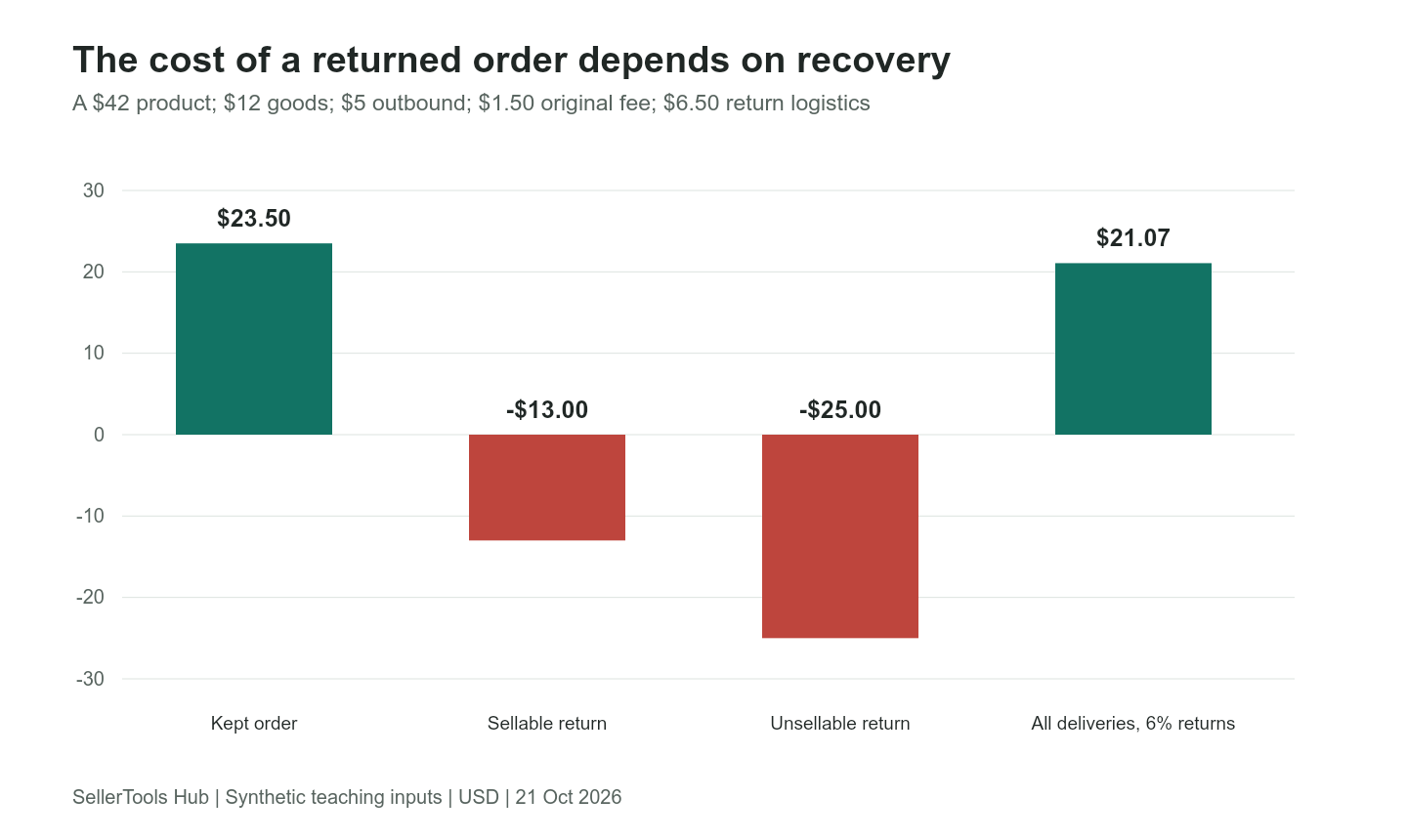
| Final contribution | $23.50 | -$13.00 | -$25.00 |
The resellable return reduces contribution by $42 + $5 + $1.50 - $12 = $36.50; $23.50 - $36.50 = -$13.00. Without inventory recovery, the reduction is $48.50, leaving -$25.00. Unsellable goods need no second $12 write-off in this model: their full cost remains in the baseline.
Incremental loss is not negative cashflow. Assuming all listed expenses are paid, either return has full-cycle net cashflow of $42 - $12 - $5 - $1.50 - $42 - $5 - $1.50 = -$25, before any resale. The resellable unit also restores a $12 inventory asset, explaining its -$13 economic contribution. Inventory recovery is not a cash receipt.
Weight outcomes across 1,000 deliveries
Suppose a mature cohort has 940 retained orders, 40 resellable returns and 20 unsellable returns. The return rate is 60 / 1,000 = 6%; two-thirds of returns recover inventory.
- Weighted loss per return: (40 × $36.50 + 20 × $48.50) / 60 = $40.50.
- Allowance per delivery: 6% × $40.50 = $2.43.
- No-return baseline: 1,000 × $23.50 = $23,500.
- Total return reduction: 60 × $40.50 = $2,430.
- Final contribution: $23,500 - $2,430 = $21,070, or $21.07 per delivery.
Cross-check directly: 940 × $23.50 + 40 × (-$13) + 20 × (-$25) = $21,070. Returned orders alone average -$17 contribution, not -$40.50: the latter is their deterioration relative to retention.
The cash bridge also reconciles: $23,500 initial cash contribution - $2,520 refunds - $300 reverse shipping - $90 handling = $20,590. Add $480 recovered inventory to reach $21,070 economic contribution. This assumes the original costs were paid and ignores payment timing. A business can therefore meet its contribution target while needing cash to fund refunds before recovered goods sell.
Download the synthetic disposition/cohort CSV. Its five mutually exclusive rows sum to 1,000 deliveries. Sum order counts and total contribution; weight per-order values by counts rather than averaging rows equally.
Return allowance assumptions
- Weighted incremental loss per return
- $40.50
- Allowance per delivered order
- $2.43
- Contribution per delivered order
- $21.07
- Average returned-order contribution
- -$17.00
Synthetic defaults assume full refunds and full landed-cost recovery on two-thirds of returns. Contribution excludes advertising and fixed overhead.
Separate reason from disposition
Reason identifies a possible cause; disposition establishes recovery. A sizing return can be pristine or damaged. Join delivery, refund, carrier, inspection and fee-credit records by order or item identifier. Keep pending inspections separate from confirmed resellable inventory.
The CSV splits returns into sizing, changed-mind, damage and opened/unsellable groups. These are illustrative categories, not benchmark rates. For partial recovery or liquidation, substitute supportable net recovery rather than assuming full landed cost. Do not count liquidation proceeds and inventory recovery for the same unit.
Missing data should remain visible: an unreceived return is not automatically unsellable, and an unconfirmed credit is not cash recovered. Report provisional estimates separately so a warehouse backlog does not masquerade as deteriorating product quality.
Connect the allowance to an operating decision
Repeated compatibility or sizing complaints warrant clearer specifications and fit images; transit damage points toward packaging or carrier investigation. Use the listing conversion checklist to investigate expectation gaps without concealing product limitations.
At this outcome mix, one additional percentage point of returns costs $0.405 per delivery. That reduces acquisition headroom before overhead. Compare any prevention expense with the expected reduction, including changes in conversion and recovery, rather than optimizing return rate alone.
Respect the return window and settlement lag
Group orders by delivery month, not refund month. Recent deliveries have had less opportunity to return. The CSV assumes a July 2026 cohort, a 30-day return window and 14 additional days for receipt, inspection and settlement, observed through October 21. Those are synthetic assumptions, not platform rules.
Use your actual policy and observed processing delays. Mark cohorts provisional while claims or dispositions remain unresolved; compare cohorts at equal ages. Keep late adjustments visible. A policy extension or backlog can make an apparently mature cohort incomplete.
Small samples are unstable: one expensive damaged unit can shift the average sharply. Report counts beside rates, inspect SKU and variant mix, and test plausible downside recovery and shipping assumptions. There is no universal sample size or stop rule that makes this estimate reliable for every product.
Reconcile before changing the allowance
Each review should reconcile delivered counts, refunds, warehouse dispositions and fee credits. Explain changes in rate separately from changes in loss severity. Assign an owner to the largest preventable cause and evaluate subsequent mature cohorts, noting promotions or supplier changes that complicate comparison.
This is contribution planning, not a complete accounting statement. Taxes, exchanges, replacements, chargebacks, customer-paid return postage and recovery markdowns need separate treatment when applicable. Keep the same boundaries between baseline and adjustments throughout.
Return economics FAQ
Is a refund simply lost revenue?
It reverses revenue, but inventory recovery, reverse logistics and fee credits determine the incremental contribution reduction.
Should retained processing fees be added again?
No. They remain in the original baseline. Add only new refund charges; subtract actual credits.
Can I value recovered stock at selling price?
Not here. Use recoverable landed cost, reduced for impairment. A later sale has its own revenue and costs.
What about a refund without a physical return?
Record the refund, zero inventory recovery, and only reverse shipping or handling actually incurred.
Does $21.07 mean I can spend that much on ads?
It is the pre-ad contribution ceiling in this simplified example, not a recommended budget. Reserve overhead, profit and uncertainty first.
What if a tool already includes returns?
Replace its allowance with the cohort-based amount or reconcile the difference. Do not subtract both allowances.
Source and verification
Shopify Payments refunds, checked October 21, 2026, states that the original credit-card processing fee is not refunded and no additional transaction fee is incurred for processing a refund. This supports retaining the original fee once, not charging it twice. Verify your own payment method and contract.